Ledger and journals
General ledger, chart of accounts, and journals, built to IPSAS for the public sector.
Operations · Business management
Finance, people, payroll, supply chain, assets, and governance in one workspace.
Werkflow Core is the web-based business management system for organisations that have to run the whole enterprise, and prove it. Each person opens a dashboard for their role. Approvals route to the right manager. Every action is written to the audit trail.
Government agencies, state-owned companies, and large privately owned companies in Namibia.
Owner Manager Accountant HR Employee Supplier Super Admin
Example
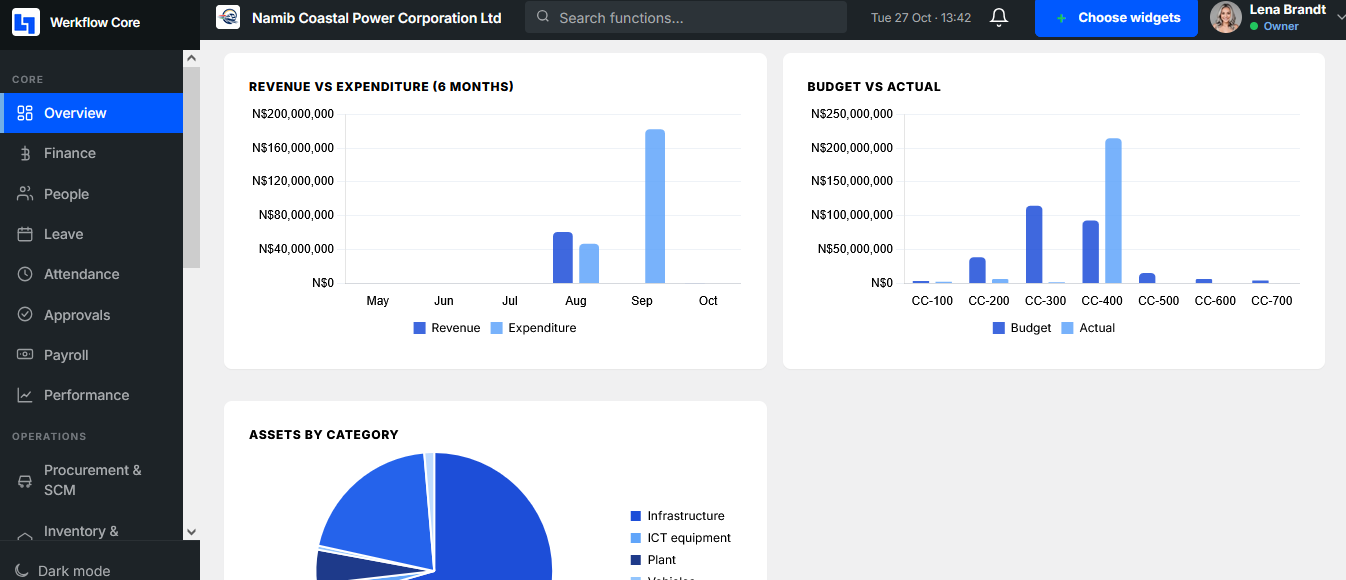
The Core dashboard, shown with a demonstration company. Your company name, documents, and numbers appear after you sign in.
The books are built for a finance team that reports to a board, an auditor, or a public-sector standard.
General ledger, chart of accounts, and journals, built to IPSAS for the public sector.
Accounts payable, accounts receivable, and payments live with the ledger, so a supplier invoice and a customer receipt are not a side spreadsheet.
Budgets are set by department and expense account, with budget-versus-actual tracking and drill-down to the entries underneath.
Bank reconciliation, tax, financial statements, and ratio analysis. Automated finance routines cover the work that should not depend on someone remembering the checklist.
Human capital management for the employee record, the time they take, and the decisions managers make about them.
Employee records and history, onboarding, and bulk import. The staff directory carries photos, and people keep a self-service profile.
Leave applications, balances, accrual, and forfeiture. Supervisors approve leave, overtime, and subsistence and travel (S&T) claims.
Clock in and clock out, ready for biometric devices when the workplace uses them.
Disciplinary and grievance cases, training, and succession planning. Workforce planning and job evaluation match employees to graded roles.
HR letters are generated from templates, so an offer or a warning starts from the record rather than a blank page.
Pay is calculated for Namibia, then leaves the system as a payslip and a bank file.
Pay runs, payslips, and bank payment files.
PAYE, Social Security (SSC), and the VET levy are part of the run.
Benefits, loans, and termination calculations, plus the payroll reports finance and HR ask for after the run.
Reviews stay attached to the person, not to a folder of spreadsheets.
Balanced scorecards, key performance areas (KPAs), and review cycles.
Individual development plans (IDPs) sit with the review, so the next step is written down with the score.
Buying starts with a request from the person who needs the thing, and ends with a supplier who can see their own paperwork.
Any employee can raise a requisition. Their supervisor or manager approves it.
Supplier register, tenders, purchase orders, contracts, and milestones.
Suppliers sign in to a separate portal and see only their own orders and documents.
Stock, the till, the vehicles, and the asset register are part of the same system as the ledger.
Stock items, more than one warehouse, transfers, and barcode or QR labels.
Tills and outlets, barcode scanning by scanner, camera, or photo, receipts, and a live stock check while the sale is happening.
Vehicles, bookings, and maintenance or service tracking.
An asset register with depreciation, revaluation, impairment, disposal, and physical verification.
Files, forms, and tasks follow the same approval habit as leave and requisitions.
Document management with team, HR, and finance drives. Each drive has its own access rules. Uploading a file again creates a new version. Search and e-signatures are included.
Workflows and forms are configurable, with approval chains and escalation when a step sits too long.
Tasks move across a board: To do, In progress, Review, Done. Announcements, internal chat, and notifications sit beside the board.
The register of risks and the numbers on a dashboard are available to the people whose role includes them.
Risk register, controls, compliance, policies, and exception tracking.
Dashboards that users can build themselves, on top of the records the system already holds.
Access is a role, a licence, and a session. The audit log is the record of what happened.
Role-based access for Owner, Manager, Accountant, HR, Employee, Supplier, and Super Admin. Licence tiers include a self-service tier for employees.
Multi-factor authentication, and single sign-on through SAML, OpenID Connect, or Active Directory. An idle timeout, a limit on how many places one user can be signed in at once, and forced sign-out.
Full audit log. Password reset by the person, or by an administrator. Backup and disaster recovery, with recovery point and recovery time targets (RPO and RTO). Company settings cover the logo, banking details, NamRA tax details, directors, and a custom login background.
A group can run more than one company without mixing the books.
Several companies and subsidiaries run on one installation. Each company's data is kept separate.
A platform console for activating companies, managing licences, and secure support access.
Other systems can be connected, and people can ask for help inside the product.
REST API, webhooks, API keys, and SCIM user provisioning, with API documentation built in.
Tickets, a knowledge base, and training material.